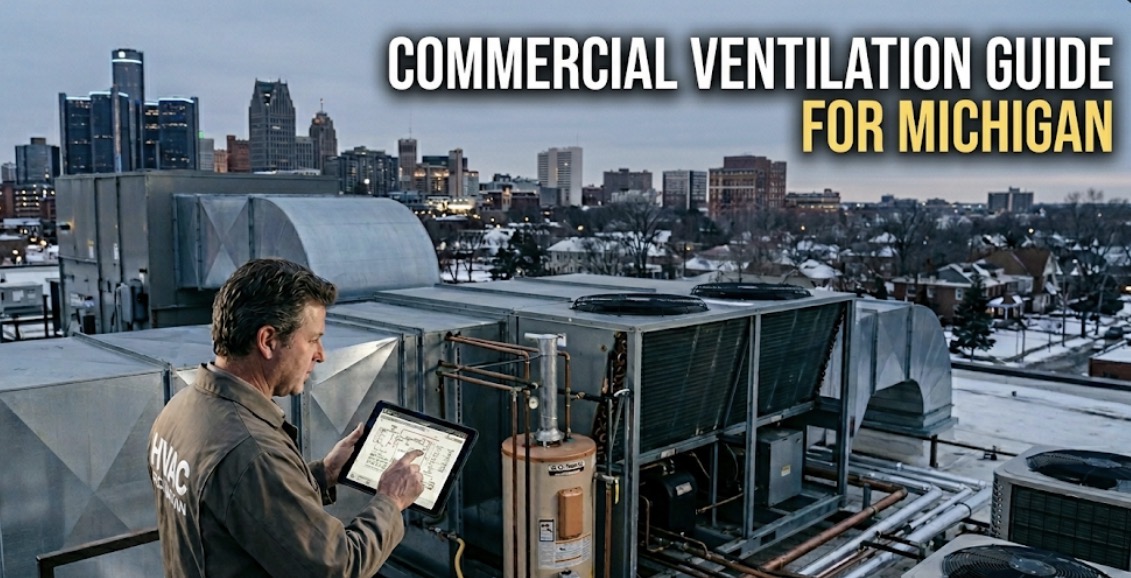
Most business owners only think about their HVAC system when it stops working. Here's why that's a costly approach - and what a smarter one looks like.
If you run a business in Southeast Michigan - a medical office, retail space, restaurant, school, warehouse, or light industrial facility - your HVAC system is infrastructure. It's as foundational to daily operations as your internet connection or your electrical service. The difference is that when the internet goes down, you call your provider. When the HVAC goes down, a surprising number of business owners aren't sure who to call, what to expect, or how to evaluate whether they're getting good service.
This article is for those business owners. Not the ones with a facilities manager handling everything, but the ones running smaller or mid-size operations where HVAC is one of a hundred things you have to think about. Here's what actually matters, what to look out for, and how to think about commercial HVAC service in a way that protects your business.
How Commercial HVAC Differs From Residential
It sounds obvious, but it's worth spelling out because the differences affect how service, maintenance, and repair are handled.
Commercial systems are generally larger, more complex, and under heavier demand. They often run 12–16 hours a day or more, compared to the intermittent cycling of a residential system. They may involve rooftop package units (RTUs), complex multi-zone systems, dedicated ventilation requirements (particularly in commercial kitchens, medical facilities, or spaces with specific air exchange mandates), and commercial-grade controls and thermostats.
The stakes around failure are also different. A homeowner without AC for two days is uncomfortable. A restaurant without proper kitchen ventilation may face a health department closure. A medical facility without temperature control may have regulatory compliance issues. The financial and operational consequences of failure are higher, which is why the approach to maintenance needs to be proportionally more rigorous.
The Hidden Cost of 'Run It Till It Breaks'
Many small business owners effectively operate on a run-to-failure model with their HVAC equipment - not by intention, but by default. There's no maintenance schedule, the system gets called when something breaks, and the decision to replace is made under the pressure of a failed system rather than on a thoughtful timeline.
This approach is expensive in ways that aren't always obvious:
• Emergency repair calls cost significantly more than planned service visits - not just in labor rates, but in parts availability (common parts fail more often in summer and winter when demand is high) and expedited shipping
• Deferred maintenance causes progressive degradation - a dirty coil that reduces efficiency by 15% costs you money on every utility bill, every month, until it's cleaned
• Unplanned downtime has real business costs — staff productivity, customer experience, potential inventory loss (refrigerated products, temperature-sensitive materials), or having to close early
• Emergency replacement decisions are almost always more expensive than planned replacements you're choosing under pressure, without time to compare quotes or financing options
The financial argument for proactive commercial HVAC maintenance is strong. It doesn't eliminate repair costs, but it substantially reduces their frequency, severity, and timing.
What a Commercial HVAC Maintenance Agreement Should Cover
Not all maintenance agreements are the same, and it's worth understanding what a thorough one looks like before you sign anything. At minimum, a service agreement for a commercial facility should include:
Filter Maintenance
Commercial systems typically have larger and more complex filter banks than residential units. Filters should be inspected and replaced on a schedule appropriate to your facility type and air quality demands. A restaurant or workshop has very different filter requirements than a standard office.
Coil Cleaning
Both evaporator coils (inside the air handler) and condenser coils (outside or on the rooftop) accumulate dirt over time. Even a thin layer of grime on a coil surface significantly reduces heat transfer efficiency. Coil cleaning is one of the highest-impact maintenance tasks for energy efficiency and should be done at least annually — twice a year for heavily used systems.
Electrical and Controls Inspection
Loose electrical connections cause resistance, which generates heat and can lead to component failure or fire. Capacitors, contactors, and relays have finite lifespans and often show measurable signs of wear before they fail outright. Catching a failing capacitor during a maintenance visit (cost: a relatively minor repair) is far better than having it fail on a 95-degree day (cost: emergency call, potential compressor damage from running without starting capacitor, significant downtime).
Refrigerant Check
Refrigerant levels that are slightly low reduce cooling capacity and put extra stress on the compressor. A slow leak that's not addressed eventually leads to compressor failure — one of the most expensive repairs in a commercial HVAC system. Refrigerant should be checked during every maintenance visit, and any leak should be located and repaired, not just topped off.
Belts, Bearings, and Moving Parts
Commercial air handlers often use belt-driven fans. A worn or improperly tensioned belt reduces efficiency and can fail suddenly, taking the entire air handler offline. Bearings in fan motors should be lubricated regularly. These are simple tasks that extend equipment lifespan significantly.
Condensate System
Commercial condensate drainage systems can be more complex than residential ones, particularly in rooftop units or multi-story buildings. Blocked condensate lines can cause water to back up, overflow, and cause water damage to ceilings, walls, and flooring — damage that far exceeds the cost of a drain cleaning.
Understanding Your Equipment's Lifecycle
Commercial HVAC equipment has a typical useful life of 15 to 20 years for well-maintained units, less for equipment that has been poorly maintained or chronically overworked. Knowing where your equipment sits in its lifecycle is important for financial planning.
A 12-year-old rooftop unit that's running but starting to show its age shouldn't necessarily be replaced immediately - but it also shouldn't be the subject of a major repair that costs 60–70% of replacement value. Your HVAC contractor should be able to give you an honest assessment of remaining equipment life and help you plan replacement on your terms rather than under emergency conditions.
Michigan also has specific climate considerations for commercial equipment. Rooftop units face significant thermal cycling between extreme cold winters and hot summers. Drainage systems are critical in winter to prevent ice damming. Equipment specifications and installation practices that work in a milder climate may not be optimal here.
What to Look for in a Commercial HVAC Contractor
This matters more than most business owners realize. Commercial HVAC work requires different skills and experience than residential work, and not every contractor who handles residential systems is equipped for commercial.
When evaluating a contractor, ask specifically about their commercial experience - what types of facilities they service, what equipment brands they're certified on, and whether they have experience with your specific system type. Ask for references from commercial clients with similar operations. Check that they carry commercial-appropriate insurance, including general liability coverage at levels appropriate for your facility.
A contractor who is vague about their commercial experience, or who gives you a residential-style estimate for a commercial system, is worth being cautious about. Commercial HVAC service is a specialized field, and the contractors who do it well tend to be direct about what they know and what they don't.
Building a Relationship Before You Need Emergency Service
The single best thing you can do for your commercial HVAC situation is to establish a relationship with a qualified contractor before you have an emergency. A contractor who knows your equipment, has your service history, and has been in your building before will respond faster, diagnose problems more quickly, and make better repair recommendations than someone walking into your facility cold.
Schedule a systems assessment. Get a maintenance agreement in place. Have someone on file to call when something goes wrong. It's not a complicated strategy it just requires doing it before the problem happens.