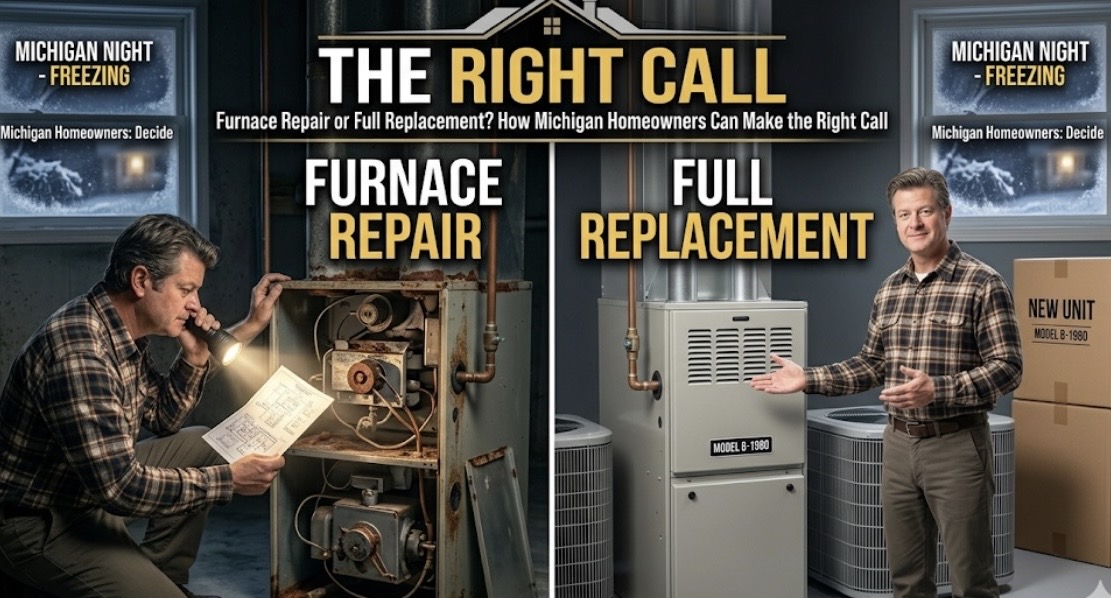
Here's how to think through your options without the pressure of making a rushed decision.
Of all the decisions homeowners face with their HVAC systems, the repair-versus-replace question on a furnace tends to be the most stressful. The stakes are high Michigan winters are unforgiving and the cost difference between a repair and a full furnace installation can be substantial. Making the wrong call in either direction has real consequences.
Repair when you should replace, and you'll spend money on a system that fails again within a year or two. Replace when a repair would have done just fine, and you've spent thousands unnecessarily. The goal of this article is to give you a clear framework for thinking through that decision — without the pressure of a cold house and a technician waiting for an answer.
Start Here: How Old Is Your Furnace?
Age is the single most important factor in the repair-versus-replace decision. Most gas furnaces have an expected lifespan of 15 to 20 years with regular maintenance. Without regular maintenance, that window shortens considerably sometimes to 10 to 12 years.
If you don't know your furnace's age, check the manufacturer's label on the unit itself. Most manufacturers encode the production date into the serial number. The format varies by brand, but it's usually the first four characters something like a letter followed by digits that indicate the year and week of manufacture. A quick search of your furnace's brand and serial number format will decode it in seconds.
Why does age matter so much? Because a furnace isn't just a burner and a blower. It's a system of components heat exchanger, inducer motor, control board, igniter, pressure switches, gas valve each of which has its own lifespan. An older furnace isn't just one component away from failure. It's potentially several components away from failure, and each repair only extends the life until the next one.
The 50% Rule (And Why It's a Starting Point, Not the Final Word)
A commonly cited guideline in the HVAC industry is the '50% rule': if a repair costs more than 50% of the price of a new furnace, and the existing unit is more than halfway through its expected lifespan, replacement is generally the smarter financial choice.
It's a reasonable starting point, but it has limitations. It doesn't account for efficiency differences, which can be significant. It doesn't factor in your specific situation how long you plan to stay in the home, whether you have financing options, or whether the timing is favorable.
Use the 50% rule as a flag, not a verdict. If a repair quote clears that threshold, it's a signal to look more carefully at replacement not necessarily to go out and buy a new furnace that day.
What High-Efficiency Furnace Installation Actually Means for Your Bills
If you're replacing a furnace that's 15 or more years old, the efficiency difference alone may justify the investment. Older furnaces typically operate at 60–80% AFUE (Annual Fuel Utilization Efficiency) meaning 20–40 cents of every dollar you spend on gas is wasted. Modern high-efficiency furnaces run at 90–98% AFUE.
In a Michigan winter, where heating season runs from October through April and sometimes longer, that efficiency difference translates to real money. A household that spends $1,800 a year heating with a 78% AFUE furnace could potentially spend $1,100–1,200 with a 96% AFUE replacement a savings of $600 or more annually. Over a 15–20 year lifespan, that's a meaningful offset against the upfront installation cost.
Michigan utilities also periodically offer rebates for high-efficiency furnace installations. It's worth checking with your gas or electric provider before making a final decision rebates can reduce the cost of a new system by several hundred dollars.
Signs a Repair Is Still the Right Move
Replacement isn't always the answer. There are situations where a repair makes clear financial sense:
• The furnace is under 10 years old and has been reasonably well maintained
• The repair involves a single, known component failure an igniter, a pressure switch, a draft inducer motor rather than multiple compounding issues
• The repair cost is well below the 50% threshold and the system is otherwise in good condition
• A professional inspection confirms the heat exchanger is intact (a cracked heat exchanger is one of the few furnace issues that almost always warrants full replacement due to both safety and repair cost)
One important note: not all repairs are equal. Replacing an igniter is a minor repair. Replacing a control board is more significant. And replacing a heat exchanger if it's even available for an older model often costs as much or more than a new furnace. Make sure you understand exactly what's being repaired and what it actually costs before agreeing to the work.
Signs Replacement Makes More Sense
The calculus tips toward replacement when:
• The furnace is 15+ years old and showing multiple symptoms unusual sounds, short cycling, uneven heat, rising energy bills
• The heat exchanger is cracked or suspected to be cracked (this is also a carbon monoxide risk and should be taken seriously)
• You've had two or more significant repairs in the past two years
• The system requires R-22 refrigerant or uses obsolete components that are expensive or hard to source
• Your current system is significantly oversized or undersized for your home a problem that no amount of repair will fix and that causes real inefficiency and comfort issues
What to Expect From a Furnace Installation
If you decide replacement is the right path, understanding what a proper installation involves helps you evaluate quotes and avoid shortcuts.
Load Calculation
A properly sized furnace starts with a load calculation an assessment of your home's specific heating requirements based on square footage, insulation levels, window area, ceiling height, and local climate data. A furnace that's too large will short-cycle (turning on and off too frequently), which wastes energy and creates uneven temperatures. A furnace that's too small will run continuously without reaching the setpoint on the coldest days.
This calculation should be done before any equipment is selected. Any contractor who quotes you a specific furnace size without doing a load calculation first is taking a shortcut.
Equipment Selection
Beyond efficiency rating, furnace selection involves choosing between single-stage, two-stage, and variable-speed systems. Single-stage furnaces run at full capacity whenever they're on. Two-stage systems can run at a lower capacity during mild weather, which improves efficiency and comfort. Variable-speed systems modulate output continuously and tend to deliver the most consistent comfort and highest efficiency at a higher upfront cost.
For most Michigan homes, a two-stage or variable-speed system is worth the premium over single-stage, given the length of the heating season. Your technician should walk you through these options with actual numbers, not just recommendations.
Installation Quality Matters as Much as Equipment Quality
A high-efficiency furnace installed with improper venting, incorrect gas pressure settings, or duct connections that don't seal properly will underperform and may cause safety issues. High-efficiency furnaces use PVC flue pipes rather than traditional metal flues a change that requires specific installation knowledge and code compliance.
Permits are required for furnace replacements in Michigan. A contractor who suggests skipping the permit to save time or money is a red flag. Permitted work is inspected, which protects you both in terms of safety and when it comes time to sell the home.
The Heating Maintenance Factor
Whether you repair or replace, this is worth saying plainly: a furnace that gets annual maintenance consistently will outlast one that doesn't by several years. The things that cause the most expensive furnace failures dirty burners, worn heat exchangers, failing motors, clogged filters are almost all preventable with routine service.
Fall is the right time for a heating tune-up in Michigan, ideally before the first hard freeze. A technician will clean the burners, check the heat exchanger, test the ignition system, measure gas pressure, and inspect flue venting all things that catch small problems before they become cold-night emergencies.
If you've inherited a home or moved into one without knowing the service history, scheduling an inspection before winter is a reasonable first step regardless of the furnace's apparent condition. What's invisible from the outside can tell a very different story when a technician takes a closer look.