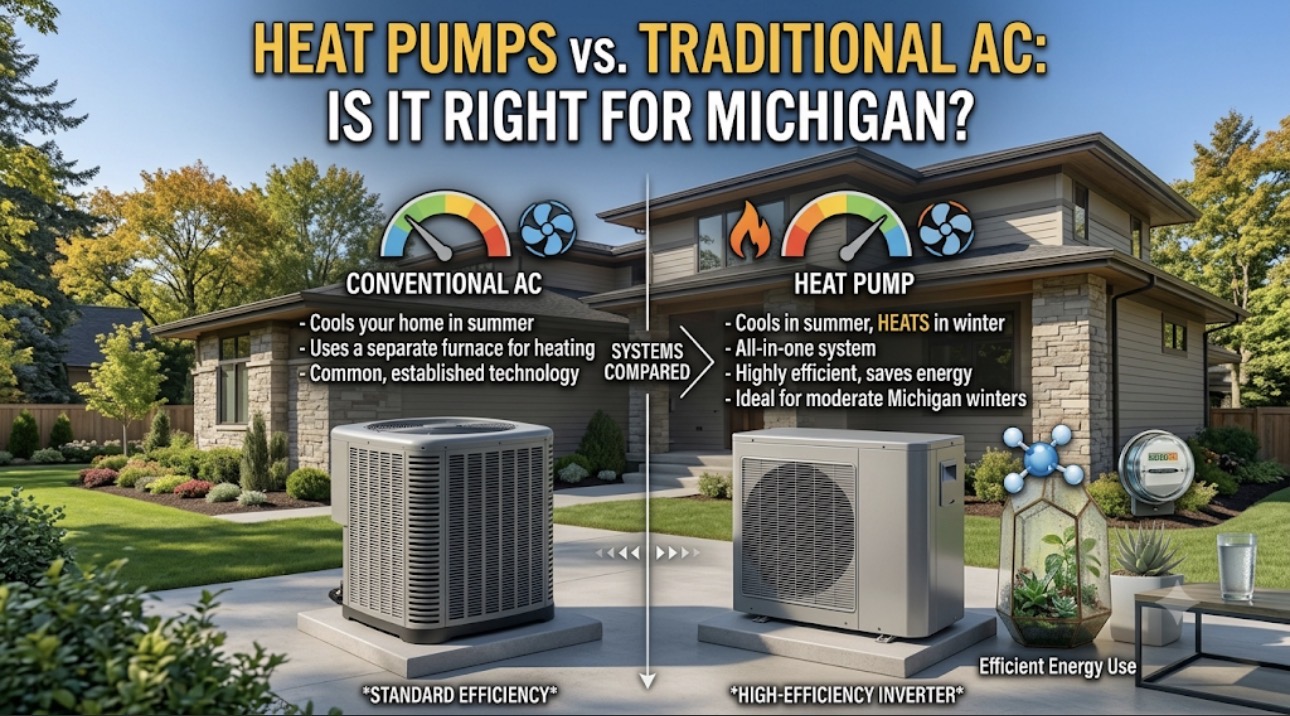
If you've looked into replacing your HVAC system in the last year or two, you've almost certainly encountered heat pumps as an option. The conversation around them has intensified significantly, driven by federal energy incentives, a broader push toward electrification, and genuine improvements in the technology particularly cold-climate performance.
At the same time, Michigan is not Arizona. We have real winters, and any heating and cooling decision needs to account for what happens in January as much as what happens in July. This article tries to give you a clear, technically honest picture of what heat pumps do, how they compare to a traditional split-system AC paired with a gas furnace, and what factors should drive the decision for a Michigan home specifically.
What a Heat Pump Actually Is
A heat pump isn't a separate category of equipment so much as a different operating mode for a refrigerant-based system. A traditional central air conditioner moves heat in one direction from inside your home to outside. A heat pump does the same thing in summer, but can reverse the process in winter: it extracts heat from outdoor air and moves it inside.
This reversal is the key insight. Even at 30 degrees Fahrenheit, outdoor air contains heat energy not much, but enough for a heat pump to extract and use. The efficiency advantage of a heat pump in heating mode is that it moves existing heat rather than generating it. An electric resistance heater (like a baseboard or electric furnace) converts one unit of electricity into one unit of heat. A modern heat pump, in mild-to-cold conditions, can move two to four units of heat for every unit of electricity consumed.
In cooling mode, a heat pump and a traditional central AC are functionally identical. The efficiency difference between a heat pump and a conventional AC for summer cooling is negligible they use the same basic refrigeration cycle.
The Cold-Weather Performance Question
This is the critical issue for Michigan. Early heat pumps struggled significantly in cold weather efficiency dropped sharply as temperatures fell below freezing, and at very low temperatures the system couldn't maintain indoor comfort without supplemental heat.
Modern cold-climate heat pumps have substantially improved this performance. Leading cold-climate models from manufacturers like Mitsubishi, Daikin, and Bosch maintain meaningful heating capacity down to -13 to -22 degrees Fahrenheit. For context, Detroit's average January low is around 21 degrees, and temperatures below 0 degrees occur only a handful of days per year in Southeast Michigan.
That said, 'maintains capacity' exists on a spectrum. A cold-climate heat pump at 5 degrees is working harder and less efficiently than it is at 30 degrees. Most Michigan installations that use a heat pump as the primary heating system still include some form of backup either electric resistance strips in the air handler, or a dual-fuel configuration that pairs the heat pump with a gas furnace.
Dual-Fuel Systems: Often the Best of Both Worlds
A dual-fuel system pairs an electric heat pump with a gas furnace. The heat pump handles all the cooling in summer and takes over heating duties in fall and spring when outdoor temperatures are above a set threshold typically 35–40 degrees, where the heat pump's efficiency advantage over gas is clear. When temperatures drop below that threshold, the gas furnace takes over.
This approach captures the heat pump's efficiency advantage during the majority of Michigan's heating season the months when temperatures are cold but not extreme while relying on the proven performance of natural gas during the coldest periods. For homes with existing gas infrastructure that aren't ready to move away from it entirely, dual-fuel systems represent a practical and financially sensible middle path.
Dual-fuel systems also provide a meaningful hedge against energy price volatility. If natural gas prices rise significantly (as they did in recent winters), the system shifts more heating load to the heat pump. If electricity rates increase, the balance shifts toward gas.
All-Electric Heat Pump: When It Makes Sense
A fully electric cold-climate heat pump without a gas backup is a viable choice for Michigan, but it requires a higher-performance system and realistic expectations about operating costs. The financial case is strongest in:
• Homes without existing gas service, where adding gas infrastructure would be a significant cost
• Homes with solar panels or plans to add them — pairing solar generation with a heat pump creates a genuinely low-operating-cost system
• New construction where the building envelope is highly efficient, reducing the heating load the system needs to handle
• Homeowners specifically prioritizing all-electric operation for environmental or energy independence reasons
For most existing Michigan homes replacing an aging gas furnace and AC combination, the calculation is more nuanced. The heat pump's efficiency advantage in heating is real but needs to be weighed against the cost differential between electricity and natural gas in Michigan, the installed cost of the equipment, and the performance expectations during extreme cold.
Efficiency Ratings: What the Numbers Mean
For cooling, air conditioners and heat pumps are both rated in SEER2 (the higher the number, the more efficient). For heating, heat pumps use HSPF2 (Heating Seasonal Performance Factor). A higher HSPF2 means the system delivers more heat per unit of electricity consumed over a heating season.
The minimum HSPF2 for heat pumps sold in the northern U.S. is currently 7.5. Cold-climate heat pumps from leading manufacturers can reach HSPF2 ratings of 10–12, representing a substantial efficiency improvement over minimum-efficiency equipment.
These numbers matter most in context. An HSPF2 of 10 means the system delivers 10 units of heat for every unit of electricity roughly three times the efficiency of electric resistance heating. Whether that advantage translates to lower operating costs than a high-efficiency gas furnace depends on current electricity and gas rates in your area.
The Bottom Line for Michigan
For most Michigan homeowners, the pragmatic approach is: if you're replacing just the AC and your furnace is relatively new and in good condition, a high-efficiency conventional AC makes straightforward sense. If you're replacing both the heating and cooling system simultaneously, a dual-fuel heat pump deserves serious consideration particularly with current federal incentives in place. If you're building new or doing a comprehensive energy efficiency renovation, a cold-climate all-electric heat pump is genuinely viable.
The worst outcome is making either decision heat pump or conventional without a clear understanding of your specific home's heating and cooling loads, your current energy rates, and what the installed costs actually are for a proper system sized and configured for your home. Get more than one quote, and make sure each quote includes a load calculation.