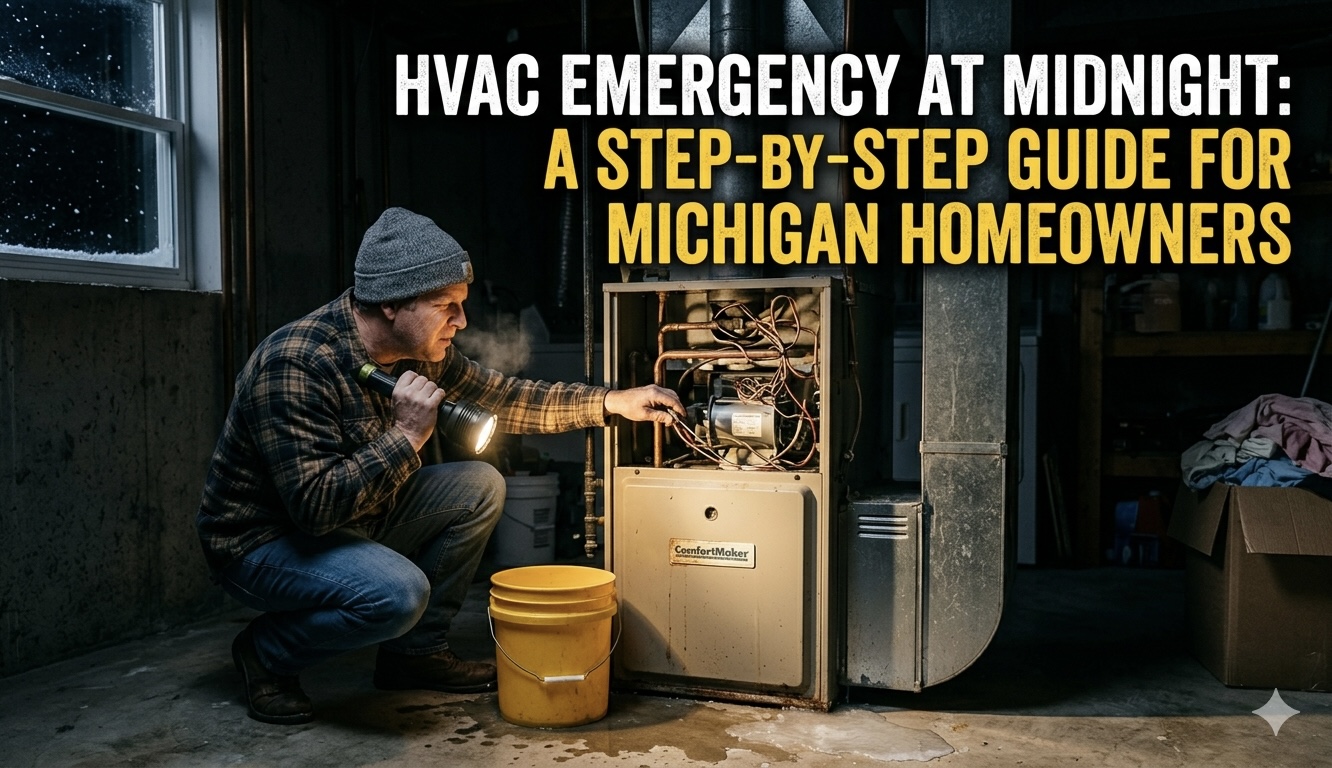
When your heating or cooling system fails unexpectedly, the first few decisions matter. Here's a calm, practical guide to getting through it safely.
It's 11:30 PM on a February night. The temperature outside is 12 degrees, and you realize the house has been getting progressively colder for the last two hours. Or it's August and your AC has stopped and tomorrow is forecast to be 94.
HVAC emergencies have a way of feeling more chaotic than they need to. In the moment, it's hard to think clearly about what to do first, what can wait, and what's genuinely dangerous. This guide is meant to be the calm voice in that situation a logical sequence you can work through before, during, and after an unexpected system failure.
Before Anything Else: Safety First
Two scenarios require immediate evacuation no troubleshooting, no waiting to see if it resolves:
Gas Leak
If you smell gas that distinctive sulfur or 'rotten egg' odor added to natural gas for detection leave the house immediately. Don't turn lights on or off, don't use your phone inside, don't try to find the source. Leave the door open as you exit. Once outside, call your gas utility company's emergency line and 911. Wait for the all-clear before re-entering. This is not an HVAC issue to troubleshoot yourself.
Carbon Monoxide Alarm
If your CO detector is alarming, treat it exactly like a fire get everyone out immediately and call 911. Carbon monoxide is colorless and odorless; you will not smell it, and symptoms (headache, dizziness, nausea) are easy to attribute to other causes. CO detectors are right far more often than people give them credit for. Don't try to locate the source yourself. Don't go back inside until emergency responders have cleared the building.
If neither of these applies, you're dealing with a mechanical failure uncomfortable, potentially costly, but not immediately dangerous. Take a breath. Work through the steps below.
Step 1: Check the Obvious Things First
You'd be surprised how often an HVAC 'emergency' turns out to be something simple. Before assuming the worst:
Thermostat
Check that it's set correctly mode (heat/cool), temperature setting, and fan setting. Batteries in thermostats die without any obvious warning, and a dead battery means a dead system. If you have a smart thermostat, check whether the app shows a connectivity issue or low battery warning.
Circuit Breaker
HVAC equipment is on dedicated circuits, and these breakers can trip without a clear cause sometimes due to a brief power surge, sometimes due to an overload. Find your electrical panel, locate the breakers labeled for your furnace, air handler, or air conditioner, and check whether any have flipped to the center or OFF position. If they have, flip them fully to OFF first, then back to ON. If the breaker trips again immediately, stop - this indicates an electrical fault that needs a professional.
Air Filter
A severely clogged air filter restricts airflow to the point where some systems will shut down automatically as a safety measure (to prevent overheating or freezing, depending on the equipment). Pull out your filter and look at it. If it's visibly packed with dust and debris, replace it with a fresh one and restart the system. This is more common than you might think, especially if filter replacement has been deferred for a while.
Power Switch
Most furnaces and air handlers have a power switch nearby that looks exactly like a standard light switch. These get accidentally switched off more often than technicians expect during cleaning, moving things around in the utility room, or just by accident. Make sure it's in the ON position.
Condensate Drain
High-efficiency furnaces and central air conditioners produce condensation during operation. This moisture drains through a condensate line. When that line gets clogged which is fairly common a float switch triggers and shuts the system down to prevent overflow. Check whether there's standing water in the condensate pan under your air handler. If there is, the drain line likely needs clearing. Some homeowners can clear a simple clog themselves; others need a technician.
Step 2: Determine the Urgency Level
Not every HVAC failure requires the same response. Here's a rough triage:
High Urgency - Act Immediately
• No heat in winter with temperatures dropping toward freezing inside
• Anyone in the home who is elderly, very young, or has a health condition that makes temperature extremes dangerous
• Active water leaking from HVAC equipment
• Unusual burning smells coming from heating equipment (different from the normal 'first heat of the season' smell - that's dust burning off; an ongoing burning smell is not normal)
Medium Urgency - Same Day or Next Day
• No cooling during a heat advisory, but adults are managing
• System running but not reaching the thermostat setpoint
• Unusual sounds that started recently - squealing, grinding, or banging
Lower Urgency Schedule Within a Few Days
• System cycling on and off more frequently than usual
• Uneven heating or cooling across rooms
• Slightly higher energy bills with no clear cause
Step 3: Protect Your Home While You Wait
If You're Without Heat
Close off rooms you're not using to concentrate warmth in a smaller space. Layer up with blankets and clothing. If you have a fireplace, this is the time to use it - safely, with the damper fully open. Electric space heaters can help in a pinch; make sure they're used according to manufacturer instructions and never left unattended or used near flammable materials.
Watch interior temperatures carefully if it's extremely cold outside. At sustained indoor temperatures below 55°F, pipes in exterior walls can begin to freeze. At 32°F, the risk becomes serious. If the house is dropping rapidly and you can't get service quickly, shutting off your main water supply and opening faucets to drain the pipes is a precautionary step worth knowing.
If You're Without Cooling
Keep blinds and curtains closed on the sunny side of the house during the hottest part of the day this alone can make a significant difference. Box fans in windows (blowing out on the hot side, pulling cooler air in on the shaded side in the early morning or evening) can help with ventilation. Stay hydrated, limit physical activity indoors, and check on neighbors or family members who may be more vulnerable to heat.
When to Call an Emergency HVAC Line vs. Waiting Until Morning
This is a judgment call, but here's a reasonable framework. If outdoor temperatures are extreme (below 20°F or above 95°F), if anyone in the home is medically vulnerable, or if there's active water damage occurring call the emergency line. The cost of an after-hours service call is real but finite. Water damage and frozen pipes are significantly more expensive, and health risks to vulnerable family members don't wait.
If temperatures are moderate, everyone in the household is healthy, and you've done the basic checks without finding an obvious fix it's often reasonable to wait until morning for a regular service call. Document what you've tried, what the system was doing when it failed, and any sounds or smells you noticed. That information helps a technician diagnose the problem faster.
The Longer-Term Lesson: Most Emergencies Are Preventable
This isn't meant to make you feel bad if you're reading this during an emergency. But it's worth saying plainly: the vast majority of HVAC failures that result in emergency calls are preceded by warning signs that went unaddressed unusual sounds, reduced performance, higher energy bills, a filter that was overdue for replacement. Annual maintenance visits exist precisely to catch these things before they become emergencies.
A technician who inspects your system every year knows its history. They'll notice when a capacitor is starting to fail, when a heat exchanger shows early signs of cracking, or when refrigerant levels are slightly low. Catching these things during a scheduled visit costs a fraction of what an emergency repair costs — and eliminates the 2 AM phone call entirely.