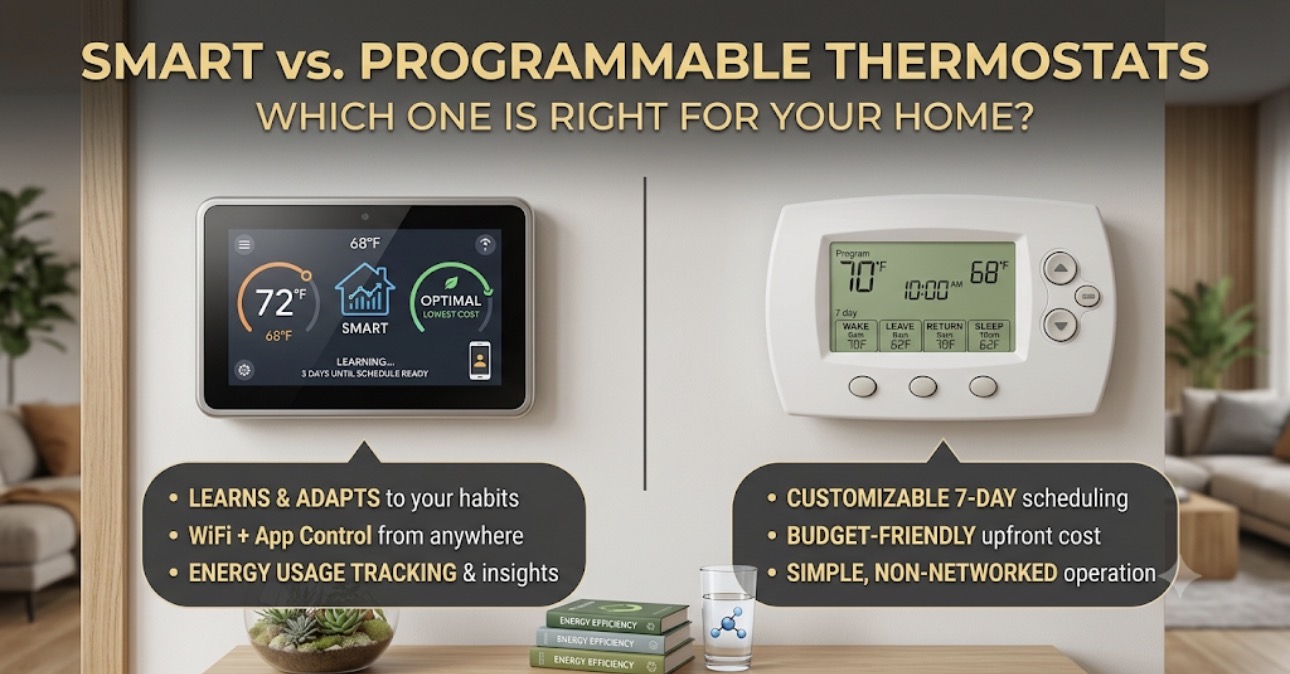
The thermostat market has fragmented significantly over the past decade. Walk into any home improvement store and you'll find manual thermostats, basic programmable models, and a range of 'smart' thermostats at price points from $50 to $300 or more. The marketing for premium smart thermostats emphasizes learning, AI, and dramatic energy savings. The reality is more nuanced - and for some households, a basic programmable thermostat is genuinely the better choice.
Here's a breakdown of what actually differentiates these products, what the evidence says about their energy savings claims, and what factors should drive the decision for a typical Michigan home.
What a Programmable Thermostat Actually Does
A programmable thermostat allows you to preset different temperature setpoints for different times of day and days of the week. The typical interface lets you set four periods per day (wake, leave, return, sleep) with different temperatures for weekdays and weekends. Once configured, it runs those schedules automatically without manual adjustment.
The energy savings potential is real and well-documented. The EPA and DOE consistently find that homeowners who use programmable thermostats correctly meaning they actually program setbacks during periods when the home is unoccupied or occupants are sleeping can reduce heating and cooling costs by 10–15% annually.
The catch is that phrase 'use correctly.' Studies over the years have found that a significant percentage of homeowners with programmable thermostats either never program them beyond default settings or override them so frequently that the effective savings are minimal. The technology works; the human implementation is the variable.
What Smart Thermostats Actually Add
Smart thermostats build on the programmable foundation with features that fall into a few distinct categories:
Remote Access and App Control
Every major smart thermostat Nest, Ecobee, Honeywell Home, Sensi connects to your home Wi-Fi and can be controlled from a smartphone app from anywhere. This is more useful than it might initially seem. The ability to turn the system on remotely before arriving home, adjust temperature during an unexpected schedule change, or confirm that the system is running correctly while you're traveling has practical value beyond pure energy savings.
Learning and Adaptation
Some smart thermostats most notably the Nest Learning Thermostat observe how you interact with the thermostat over time and attempt to build a schedule based on your behavior. They track when you're home and away using occupancy sensors and phone location, and adjust setpoints accordingly.
The learning feature works reasonably well in households with highly consistent schedules. It works less well in households where schedules are irregular shift workers, families with variable routines, or homes where multiple people have different temperature preferences. In practice, many users end up manually adjusting the learned schedule to correct for the system's imperfect inferences.
Occupancy Sensing
Most smart thermostats include one or more occupancy sensors infrared motion detectors that detect whether anyone is in the home. When no motion is detected for a period of time, the thermostat can shift to an energy-saving mode, then restore comfort settings when occupancy resumes.
Some systems, like the Ecobee, support remote room sensors placed in different areas of the home. This addresses a real limitation of single-thermostat control in larger homes: the thermostat's location doesn't always reflect conditions throughout the house. A bedroom sensor that tells the system it's warmer than the hallway thermostat shows can improve both comfort and efficiency.
Utility Integration and Demand Response
Several smart thermostats can integrate with utility company demand response programs. During periods of peak grid stress hot summer afternoons when everyone's AC is running simultaneously utilities may request small, temporary temperature adjustments from participating customers in exchange for bill credits. The smart thermostat makes this automatic and within preset limits you control.
DTE Energy has offered demand response programs for Michigan customers. If you're enrolled in or considering such a program, smart thermostat compatibility is relevant.
The Actual Energy Savings: Realistic Numbers
Smart thermostat manufacturers cite impressive energy savings figures Nest's published estimate is 10–12% on heating and 15% on cooling. Independent research generally finds more modest results, typically 8–12% combined, with significant variation based on prior thermostat behavior, climate, home characteristics, and how actively the thermostat features are used.
In Michigan, where heating costs are significant and the heating season is long, even 10% savings on an annual heating bill of $1,200–1,500 represents $120–150 per year. At a retail price of $150–250 for a quality smart thermostat, the payback period is roughly one to two years a reasonable investment.
The more important comparison, though, is against a correctly programmed basic programmable thermostat. The savings difference between a smart thermostat and a well-programmed $30 programmable model is relatively small perhaps 3–5 percentage points. The real advantage of a smart thermostat is that it's more likely to actually realize those savings because it requires less manual programming discipline.
Compatibility: What You Need to Check First
Before purchasing any thermostat, check compatibility with your HVAC system. Most forced-air systems are straightforward, but some configurations require attention:
• High-voltage systems (electric baseboard heat) require high-voltage compatible thermostats standard smart thermostats are designed for low-voltage systems and are not compatible
• Heat pumps require thermostats with O/B reversing valve control most smart thermostats support this, but verify
• Multi-stage heating and cooling systems need a thermostat with multi-stage support
• The C-wire (common wire) question: most smart thermostats require a C-wire for continuous power. Many older HVAC installations don't have one. Some smart thermostats include adapter kits; others require an electrician or HVAC technician to run a C-wire
If you're uncertain about compatibility, a professional thermostat installation takes about an hour and includes a compatibility check it removes the risk of purchasing a thermostat that doesn't work with your system.
Which Makes More Sense for Your Household?
A basic programmable thermostat is the right choice if your schedule is consistent and predictable, you're comfortable with basic programming, and the upfront cost matters. It will deliver equivalent energy savings to a smart thermostat if used correctly the 'if' is the key variable.
A smart thermostat makes more sense if your schedule is variable or you want automatic adaptation, you travel and value remote access and monitoring, you're interested in utility demand response programs, or you simply want the convenience of app control and the confidence that the system is optimizing without requiring your ongoing attention.
For households with specific HVAC equipment multi-stage systems, heat pumps, zoned systems the more sophisticated control logic of a smart thermostat can deliver real performance benefits beyond energy savings, including better management of staging and humidity control features that basic programmable thermostats can't access.