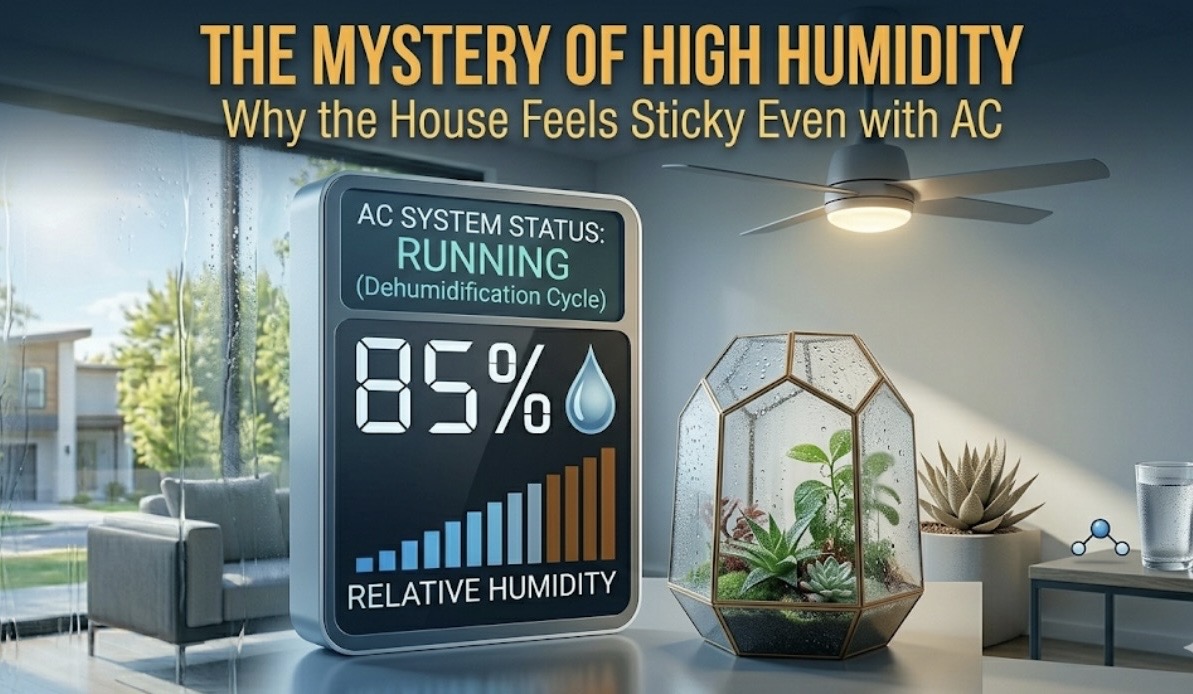
Temperature is only part of the comfort equation. Michigan summers can be brutally humid, and if your HVAC system isn't managing moisture properly, the thermostat number means less than you think.
There's a specific kind of discomfort that Michigan homeowners know well: it's 77 degrees inside, the air conditioner has been running all day, and the house still feels sticky and oppressive. You drop the thermostat to 74, then 72, and it still doesn't feel right. The air feels heavy. Windows fog up. Wood floors creak more than usual. Something is off.
That something is humidity. And while most people think of air conditioning as a temperature problem, it's equally a moisture problem, and the two are directly connected.
How Air Conditioning and Humidity Are Related
Your air conditioner doesn't just cool air. It dehumidifies it as a natural byproduct of the cooling process. Here's what actually happens: warm, humid air from your home is drawn across the cold evaporator coil inside your air handler. The coil's surface is cold enough that moisture in the air condenses on it the same way a cold glass sweats on a summer day. That water drips into a condensate pan and drains out of the house. The air that continues through your ducts is both cooler and drier.
When this process works correctly, your AC keeps both temperature and humidity in check simultaneously. When something disrupts it an oversized system, a mechanical issue, inadequate runtime, humidity control suffers even when the temperature looks fine on the thermostat.
The Oversized AC Problem
This is one of the most common and least-discussed causes of chronic indoor humidity problems in Michigan homes. An air conditioning system that's too large for the space it's cooling will reach the thermostat setpoint very quickly, often in 5 to 10 minutes and then shut off. This is called short-cycling.
The problem is that meaningful dehumidification requires sustained runtime. An AC that runs for 8 minutes, shuts off, runs for another 8 minutes, and repeats throughout the day never runs long enough in any single cycle to remove significant moisture from the air. The temperature number on the thermostat looks right, but the relative humidity inside climbs to 65, 70, even 75 percent, well above the 45–55% range that feels comfortable and below the threshold where mold becomes a concern.
If your home has always felt humid in summer regardless of the AC running, and especially if the system was installed within the last 10–15 years, oversizing is worth investigating. A load calculation by a qualified HVAC technician can determine whether your system's capacity is actually appropriate for your home.
What 'Relative Humidity' Actually Means in Practice
Relative humidity (RH) is expressed as a percentage, the amount of moisture in the air relative to the maximum amount that air at that temperature can hold. At 100% RH, the air is fully saturated and condensation forms on surfaces. At 30% RH, the air is quite dry.
The comfort zone for most people is roughly 40–55% RH. Below 35%, the air starts to feel dry, skin and sinuses feel it, static electricity increases, and wood materials in the home can dry out and crack. Above 60%, the air starts to feel muggy, the body's ability to cool itself through sweat evaporation is compromised, and conditions become favorable for dust mites, mold, and other biological growth.
Southeast Michigan summers regularly produce outdoor humidity in the 70–85% RH range during July and August. Every time a door or window opens, every breath taken inside, every shower all of it introduces moisture into your home. Your HVAC system is the primary mechanism for removing it.
Signs Your Home Has a Humidity Problem
• The house feels muggy or heavy even when the AC is running
• Condensation on windows or window sills, especially in the morning
• A persistent musty smell, particularly in basements or rooms with poor air circulation
• Allergy or asthma symptoms that seem worse indoors
• Hardwood floors that feel soft, spongy, or that have developed gaps or warping
• Paint or wallpaper that peels or bubbles near exterior walls
Your AC's Cooling Mode vs. Dehumidification Mode
Most central air conditioners don't have a dedicated 'dehumidify' setting, dehumidification is a byproduct of the cooling process. However, some modern systems and thermostats offer a specific dehumidification mode that runs the system differently to prioritize moisture removal even when the temperature is already at setpoint.
In dehumidification mode, some systems run the fan at a lower speed, which increases the amount of time air spends in contact with the cold evaporator coil. More contact time means more condensation and more moisture removal per cycle. This can be noticeably effective in homes where humidity is the primary complaint rather than temperature.
If your thermostat doesn't offer this option and humidity is a persistent issue, it's worth asking about thermostats that include dehumidification control as part of an upgrade, many modern smart thermostats offer this feature.
Whole-Home Dehumidifiers: When They Make Sense
For homes with significant humidity problems that an AC alone isn't fully addressing, a whole-home dehumidifier installed in the ductwork is a more comprehensive solution. Unlike portable dehumidifiers, which are effective in a single room, require manual emptying, and consume meaningful energy, a whole-home unit works with your HVAC system to treat air throughout the house continuously.
These units are particularly useful in Michigan homes with finished basements, crawl spaces, or older construction that allows significant moisture infiltration. They're also a practical solution for the shoulder seasons, spring and fall, when outdoor humidity is high but temperatures don't justify running the AC.
A whole-home dehumidifier can maintain indoor RH in the 45–55% target range year-round, which has documented benefits for respiratory comfort, allergen control, and the preservation of wood materials and furnishings in the home.
Simple Steps That Help
While equipment solutions address the root issue, there are behavioral adjustments that reduce the humidity load your HVAC system has to manage:
• Run kitchen and bathroom exhaust fans during and for 15–20 minutes after cooking and showering, these are significant point sources of moisture
• Keep exterior doors closed as much as practical during high-humidity days
• Check that your dryer vents to the outside (not into a crawl space or attic — a surprisingly common issue in older Michigan homes)
• Make sure window AC units are properly sealed in their openings — gaps around the unit allow warm, humid outdoor air to infiltrate directly
• Keep your HVAC filter clean and changed on schedule, a clogged filter reduces airflow over the evaporator coil, reducing both cooling and dehumidification efficiency
When to Have Your System Assessed
If you've lived with a humid house for multiple summers and accepted it as normal, it may be worth having an HVAC technician take a look at the system with humidity control specifically in mind. The conversation should cover your system's size relative to your home, whether the evaporator coil and drain system are clean and functioning, and whether your thermostat offers any dehumidification control features.
In many cases, the issue is addressable without major equipment changes. In others, a whole-home dehumidifier or thermostat upgrade provides a substantial improvement in comfort that homeowners often describe as more noticeable than a temperature adjustment. Feeling comfortable in your home during a Michigan summer shouldn't require keeping the thermostat at 68 degrees.