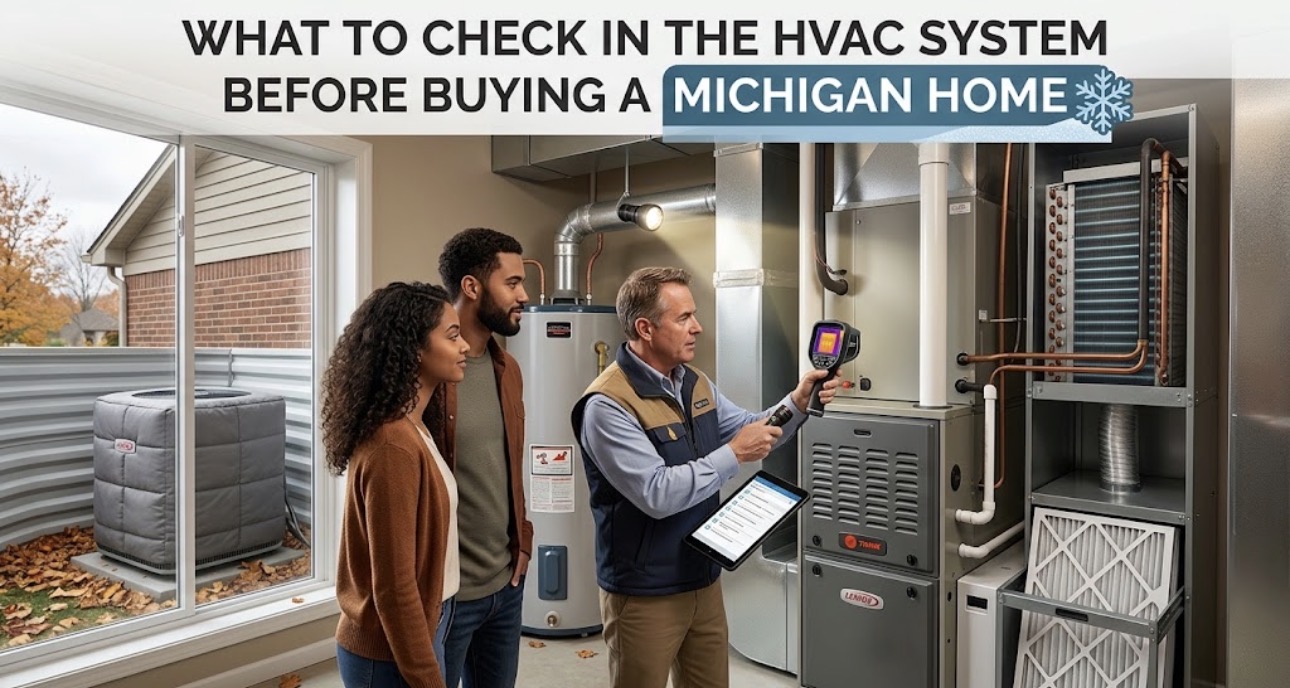
A standard home inspection gives you a general picture of an HVAC system’s condition. But for one of the most expensive systems in the house, ‘general’ often isn’t enough. Here’s what to look for and why it matters more in Michigan than most places.
Buying a home involves evaluating a lot of things at once, and HVAC systems are easy to underestimate in that process. The inspector says the furnace is ‘functional’ or ‘at end of useful life,’ and you move on to the next line item. But HVAC equipment is expensive to replace, its condition affects both your comfort and your utility bills from the day you move in, and in Michigan, where winters are serious and heating season runs nearly half the year, there’s less margin for inheriting a system that’s quietly failing.
This guide is for homebuyers who want to go into a purchase knowing the actual condition of the heating and cooling system, not just whether it turned on when the inspector tried it.
What a Standard Home Inspection Actually Covers
A general home inspector checks HVAC systems, but the scope is typically limited. They’ll verify that the furnace starts and produces heat, that the air conditioner runs and produces cooled air, that the thermostat appears to function, and that there are no immediately obvious safety concerns, like a furnace with visible flame rollout or an AC unit that’s heavily corroded. They are generalists, not HVAC technicians.
What a general inspector usually doesn’t do: measure refrigerant levels, test capacitors and electrical components, inspect the heat exchanger closely for cracks, assess duct condition, evaluate system efficiency, or give you a reliable estimate of remaining useful life. These are the things that determine whether you’re buying a system that has five good years left or one that needs replacement within the next 12 months.
For any home where the HVAC system is more than 8 to 10 years old, or where the inspection report flags any concerns about the system, a separate HVAC-specific inspection by a licensed technician is a worthwhile investment before closing.
The Age Question: Why It’s the Starting Point
Before anything else, find out how old the HVAC equipment is. This information should be available from the listing, the seller’s disclosure, or the equipment itself. Most manufacturers encode the production date in the serial number, and decoding it takes about 30 seconds with a brand name and serial number search.
The age matters because it frames everything else. A 5-year-old furnace that has a minor issue is a repair. A 17-year-old furnace with a minor issue is a system that may need replacement within the next one to three years regardless. The repair cost is the same; the financial context is entirely different.
Standard useful life for Michigan HVAC equipment, as a rough benchmark: gas furnaces typically last 15 to 20 years with maintenance, less without. Central air conditioners run 12 to 17 years. Water heaters, which are often inspected alongside the HVAC system, typically last 8 to 12 years for tank units, longer for tankless. Any equipment near or past these ranges should be factored into your offer price or negotiation.
What to Ask the Seller
Before or during the inspection period, ask for whatever service records exist. Sellers who have maintained their systems regularly often have records, receipts from annual tune-ups, documentation of repairs, filter change logs. The presence of records is a positive sign. Their absence doesn’t necessarily mean neglect, but it means you’re starting from less information.
Specific questions worth asking:
• When was the furnace or air conditioner last professionally serviced?
• Have there been any repairs in the past two to three years, and if so, what were they?
• Has the system ever had refrigerant added? If so, was the leak identified and repaired, or just recharged?
• Are there any known issues with the ductwork, specific rooms that don’t heat or cool well, or comfort complaints in the home?
• Has the heat exchanger been inspected recently?
A seller who has been in the home for years and maintained the system will usually be able to answer these questions. A seller who can’t answer any of them is telling you something about the home’s maintenance history, even if indirectly.
The Heat Exchanger: The Most Expensive Thing to Miss
For homes with gas furnaces, which covers the majority of Southeast Michigan, the heat exchanger is the most critical component to evaluate before purchase. The heat exchanger is the metal component that separates combustion gases, including carbon monoxide, from the air that circulates through the home. A cracked or failing heat exchanger is both a safety hazard and, in most cases, a total-replacement situation. Heat exchanger replacement on an older furnace typically costs nearly as much as a new furnace, making replacement the more sensible financial choice.
A general home inspector may not identify a cracked heat exchanger during a standard inspection. This is not a criticism of home inspectors. Crack detection in a heat exchanger requires specific tools and training. It’s a reason to have a qualified HVAC technician inspect the furnace separately if there’s any uncertainty, particularly on older equipment.
The consequence of missing a cracked heat exchanger is significant: you move in, run the furnace through your first Michigan winter, and discover the issue through a carbon monoxide alarm or, in the worst case, symptoms of CO exposure. At that point, the furnace needs to be replaced immediately, without the negotiating leverage you would have had before closing.
Evaluating the Air Conditioning System
If you’re purchasing in spring or summer, testing the AC is straightforward. In fall or winter, it’s trickier. Most technicians won’t run an air conditioner when outdoor temperatures are below 60 degrees, because doing so can damage the compressor. In a cold-weather purchase, you’re relying on the inspection of static components: the physical condition of the outdoor condenser unit, the age and apparent condition of the equipment, and whatever the seller can tell you about its history.
Things a technician can assess even without running the system include: the condition of the condenser coil and fins, whether the refrigerant lines are properly insulated, the condition of the capacitors, which can be tested without running the unit, the electrical connections and disconnect, and whether the unit shows signs of prior damage or significant rust.
If the AC inspection has to be deferred because of the season, negotiate for a contingency that allows a full operational test once temperatures allow, or ask for a credit toward a potential repair or replacement if the system is found to be significantly deficient.
Ductwork: The Part Nobody Thinks About
Duct condition rarely gets the attention it deserves in a home purchase. Ducts in older Michigan homes, particularly those with unfinished basements or crawl spaces, can have disconnected sections, significant leakage, inadequate insulation, or debris accumulation that affects both air quality and system efficiency from the moment you move in.
Signs of duct problems include: rooms that are consistently hard to heat or cool, high utility bills relative to the home’s size, visible damage or disconnection in accessible duct sections in the basement or mechanical room, and excessive dust throughout the home even after cleaning.
A duct inspection, which involves checking accessible sections visually and, in some cases, using a blower door test to quantify leakage, is not standard in a home inspection but can be requested as a separate service. In a home where duct condition seems questionable based on the above signs, it’s worth doing.
How to Use What You Find
The goal of a thorough pre-purchase HVAC assessment isn’t to find reasons not to buy a home. It’s to go into the purchase knowing what you’re inheriting and being able to make informed decisions accordingly. A home with an aging furnace and AC isn’t necessarily a problem. It’s a negotiating point. The cost of replacement can be reflected in the offer price, the seller can be asked to replace equipment before closing, or a credit can be negotiated that gives you the flexibility to handle it on your own timeline.
What you want to avoid is discovering a $6,000 furnace replacement or a $8,000 AC installation in your first year of ownership because the pre-purchase inspection didn’t go deep enough. In Michigan, where HVAC systems carry a heavier load than in milder climates and where the consequences of a mid-winter heating failure are genuinely significant, that due diligence is worth the time and cost it takes to do properly.